
Image via Hendrickson
(Image licensed under Creative Commons Attirbution-ShareAlike 3.0)
There is nothing more fascinating in the aviation world than the “black projects”
– aircraft programs that are so secret that even those with the highest
security clearance may have no idea they exist. But occasionally the
veil of secrecy is accidentally lifted – or projects are declassified –
offering a fleeting glimpse into this shadowy world. Here we take to
the air with six different planes – some now released into the public
domain, others still highly classified or even non-existent.
TR-3A Black Manta

Images by Adrian Mann
Allegedly active during the 1980s and ’90s, little is known of the TR-3A Black Manta
beyond rumour and hearsay. Popularly embraced as a subsonic stealth
aircraft manufactured by Northrop Grumman (famed for its “flying wing”
designs), the TR-3A was rumoured to have been used in the Gulf War in
conjunction with F-117A stealth fighters, but little evidence exists to
support this. Another theory – again unsubstantiated – holds that the
vehicle identified as the TR-3 was a prototype for the B-2 Spirit.
 (Image: Area51ZONE.com)
Two 1977 designs
from Teledyne Ryan, a firm specialising in unmanned aerial vehicles,
have been linked to the TR-3A. This stems in part from the fact that
“TR” stands for Teledyne Ryan – a fanciful connection considering “TR”
is well known to denote “tactical reconnaissance. Teledyne Ryan was
purchased by Northrop Grumman in 1999, adding fuel to the fire of
conspiracy theory. But aside from a patent (below) that is said to
resemble the configuration of whatever aircraft has been identified with
the TR-3A, there is little, if any, credible evidence linking it to
Teledyne Ryan.
 (Image: United States Patent 4019699)
The designation “TR-3″ likely came about due to confusion with another black project, Tier III, which led to the RQ-3 Darkstar.
Another theory holds that the aircraft dubbed the TR-3 may have grown
out of the Tactical High Altitude Penetrator (THAP) studies, of which
little exists in the public domain. This article
discusses THAP’s potential mission as a recon-strike platform, which
could account for a plethora of sightings throughout the 1980s and
’90s. However, there is significant debate over whether THAP progressed
to the flight testing stage. If THAP was not responsible for the
“TR-3A” sightings, it’s possible another secret demonstrator associated
with the A-12 Avenger programme (below) could have been…
Flying Triangle dubbed “TR-3B”
The online world is buzzing with information about the alleged “TR-3B“,
from rumours of its fantastical capabilities to intriguing video
footage. Yet despite numerous sightings suggesting the existence of a
large triangular aircraft that can fly slowly and quietly, little
information exists about this rumoured black project. Like the TR-3A
above, the designation “TR-3B” is almost certainly a misnomer.
The most dramatic claims frame the
“TR-3B” as a nuclear powered tactical reconnaissance aircraft capable of
disrupting gravity. But a more likely – and in many ways more
interesting – argument for these strange flying triangles, is that
they’re lighter-than-air
vehicles or some sort of stealthy troop transport aircraft. Given the
technologies proven by Have Blue and Tacit Blue in the 1970s and ’80s
and the number of projects that have allegedly been tested at Groom Lake
since that time, it’s not impossible to think that some of these flying
triangle reports may have some substance to them, if not under the
designation TR-3B.
A-12 Avenger II (and the Mysterious Jet that May Have Preceeded it)

Image via U.S. Navy
The A-12 Avenger II
was envisioned by McDonnell Douglas and General Dynamics as an
all-weather, carrier-based stealth bomber for the U.S. Navy and
Marines. Shrowded in secrecy at the time of development in 1983, the
A-12 reportedly gained the nickname “Flying Dorito”. Concept drawings
and mock-ups show a flying wing design in the shape of an isosceles
triangle, with the cockpit near the apex.
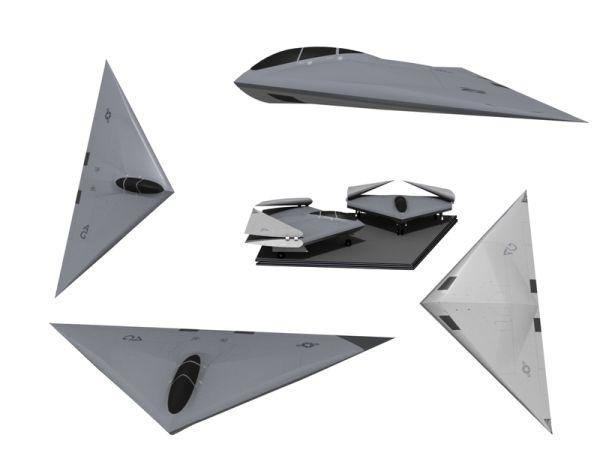
Image by Anynobody
(Image licensed under Creative Commons Attirbution-ShareAlike 3.0)
Development
of the A-12 was hampered by problems. The project was cancelled in
January 1991 by then-Secretary of Defense Dick Cheney when the estimated
price of each plane allegedly hit $165 million. The cancellation was
said to be a breach of contract, resulting in years of legal wrangling.
In 2009, a court finally ruled in favour of the government and ordered
the contractors to pay more than a $2 billion in charges, but the battle
ranges on to this day.

Images via U.S. Navy
After the cancellation of the A-12
Avenger II the Navy purchased the F/A-18E/F Super Hornet. While there
was never a full scale prototype, an earlier (1976 – 1984) classified
General Dynamics technology demonstrator called Model 100 (funded under
the Have Key program) may have paved the way for the cancelled A-12. It has been suggested that this aircraft remains secret due to the ongoing legal issues. The A-12 has also been linked to a secret plane called Sneaky Pete, which may or may not be the Model 100, or a development thereof. We were able to locate one A-12 mock-up thanks to those savvy online explorers at Virtual Globetrotting.
X-44 Manta

Image via strange-mecha.com
(Image licensed under Creative Commons Attirbution-ShareAlike 3.0 Unported)
The X-44 Manta
was a conceptual design by Lockheed Martin, based on the original F-22
Raptor (below). The X-44 was essentially a tailless Raptor with large
delta wing and advanced thrust vectoring nozzles replacing normal
aerodynamic control surfaces. Benefits would be a more stealthy, light
airframe, with increased fuel volume and maneuverability. The plan was
to convert an early F-22 prototype but the program was allegedly
terminated in 2000. The X-44 render looks similar to the proposed FB-22, reportedly cancelled in 2006.

Image via Rob Shenk
(Image licensed under Creative Commons Attribution-Share Alike 2.0 Generic)
It’s hard to know what to make of many
alleged black projects. Could some of these exotic aircraft be one and
the same? How much disinformation is out there? The X-44 was
essentially a flying wing design with a name similar to the TR-3A “Black
Manta”, although in the X-44′s case, MANTA apparently denoted
Multi-Axis No-Tail Aircraft. Could this be a case of one black
project’s name being mistakenly attributed to another, like TR-3 and
Tier III? In 2005, GlobalSecurity.org reported that the X-44 designation may be reserved for a possible NASA full-scale manned tailless flight control demonstrator.
HALO (High Altitude Low Observability) / BAE Replica
 (Image: Stridus, public domain)
Like other black projects, Britain’s
effort to create a stealth demonstrator remains shadowy, despite
cancellation in the 1990s. The Replica program was a BAE Systems design study tied in with the RAF’s now defunct Future Offensive Air System (FOAS). It is known to have run from 1994 to 1999, with a full-sized mock-up subjected to rigorous testing to determine its radar cross section (above).
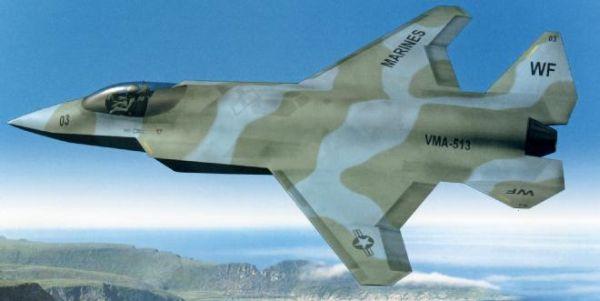
Image via Planeman
(Image courtesy of AboveTopSecret.com (CC-Attribution-NonCommercial-NoDerivs 2.5)
FOAS set out to replace the RAF’s
Tornado GR4 jets with a range of manned and unmanned platforms by 2017.
The program was cancelled in June 2005 after the UK joined the U.S.
Joint-Unmanned Combat Air System (J-UCAS) program, which was itself
cancelled the next year but later revived as the Navy-only UCAS-D program. After the termination of FOAS, knowledge gained from Replica was poured into the Joint Strike Fighter (JSF).

Images via United States Air Force
Initial arguments over Britain’s
access to the JSF source code prompted Britain to consider a potential
alternative. While likely referring to an adapted Eurofighter Typhoon, Replica
remains in the shadows, despite public acknowledgement of the program
and photos of the full scale mock-up stored at BAE Warton. This could
be due to the ongoing use of Replica’s technology in forthcoming
projects, such as the JSF, but also Taranis,
a BAE unmanned demonstrator. Again publicly acknowledged, Taranis is
set to fly next year although sightings suggest it – or perhaps
something else – flew in 2009, which the British government vehemently
denies.
Aurora – Hypersonic Spyplane
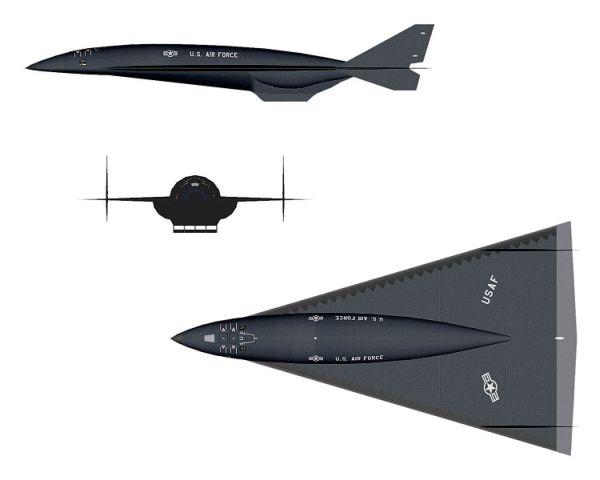
Image via Hendrickson and Foxbat
(Image licensed under Creative Commons Attirbution-ShareAlike 3.0)
The Aurora spyplane is the world’s
most famous top secret aircraft, and a reliable photograph would be one
of the most coveted finds in the history of classified aviation.
Historically presented as a hypersonic replacement for the ageing SR-71
Blackbird spyplane (below), there’s considerable evidence available in
the public domain to suggest no specific aircraft called “Aurora” ever
existed.

SR-71 Blackbird (image via U.S. Air Force)
The name “Aurora” reportedly slipped
out in the 1985 US budget alongside an allocation of $455 million for
“black aircraft production”. Excited journalists, writing in the March
1990 edition of Aviation Week & Space Technology,
linked “Aurora” to the reported black aircraft, and later to a family
of exotic aviation projects, claiming that by 1987 funding had reached
$2.3 billion. Ben Rich, former director of the Lockheed Skunk Works
(which built the F-117, below), said there never was a hypersonic
Blackbird follow-on and claimed Aurora was the name given to the B-2
Stealth Bomber competition funding.

F-117 Nighthawk (image by U.S. Air Force)
Helping to fuel the Aurora legend was a disjointed catalogue of sightings
and mysterious sonic booms. The most compelling sighting came in
August 1989, when Chris Gibson, an engineer aboard the Galveston Key rig
in the North Sea, observed a strange isosceles triangle-shaped aircraft
refuelling from a KC-135 Stratotanker, escorted by two F-111 bombers.
Gibson, a member of the Royal Observer Corps and trained aircraft
recognition expert, could not identify the mysterious plane.

Image via Google Earth
In the early 1990s, the disclosed “Aurora” designation and the “North Sea sighting”
were linked to several other reports that helped perpetuate the story
of a top secret SR-71 follow-on. One was a report of an aircraft over
Amarillo, Texas, with an engine described as emitting a “strange, loud
pulsating roar”. Caught on film was an alleged “donuts-on-a-rope”
contrail that has become synonymous with the Aurora myth. While some
attribute this to a potential pulse wave detonation engine, others have
argued the contrails could have been made by ordinary jet aircraft.

Images via Google Earth
Finally, a series of bizarre sonic
booms heard over California up until 1993 were attributed to Aurora
after seismologists concluded they did not characterise earthquakes, but
indictated “something at 90,000 feet, Mach 4 to Mach 5.2″.
Intriguingly, each unexplained sonic boom came on a Thursday morning
between 6 and 7am. In addition, Groom Lake
(Area 51) has a six mile long runway, now closed, that some say would
be a requirement for testing a high speed, mach 5 plus, aircraft.
It’s telling that, more than 20 years
after Aurora debuted in aviation and popular science publications, no
solid evidence has been found to support its existence, despite the hype
and hordes of investigators digging for information. At this point it
seems likely that the top secret aircraft known as Aurora stems from
sightings of various aircraft (some potentially black projects) and not
necessarily a single airframe. That said, Chris Gibson’s sighting and
the strange skyquakes remain a mystery to this day.
If you enjoyed this article, explore more urban ghosts within our archives. You can also subscribe to our feed, become our friend
Darren Perks
UFO Investigative Researcher and Media Contributor
UFO: Flying Triangles
Posted: 29/09/2012
There are thousands of UFO sightings around the world every year, but a high percentage of them relate to one very common UFO and shape....
Strange flying black triangle UFOs


I myself witnessed one on 30 March 1993, which was part of the famous UK Cosford UFO incident, and I became one of thousands of people who have witnessed these strange craft in our skies.
Read more about the Cosford UFO incident here: Cosford UFO
But what are they?
They are large, triangular-shaped UFOs, often black in colour, with rounded corners and making a low, humming noise. They disappear to the horizon at unbelievable speed. They are ususally big craft and show up from nowhere in the blink of an eye.
The first sighting of these mystery triangles was recorded and reported in 1965. Some say they were first sighted in 1950s. For some time people have said they are secret military projects - the next generation stealth aircrafts. But why are they flying the same way since sixties. How come the technology never changed in more than 50 years?
According to many ufologists like myself, these UFOs are the outcome of direct transfer of technologies from extraterrestrials to human civilization in different parts of the world. They are believed to be reverse engineered from crashed UFOs, and have been developed behind closed doors at top secret military facilities and bases around the world. One such facility is Groom Lake aka Area 51 in Nevada USA: AREA 51
The triangle shaped UFOs are said to use anti-gravity propulsion. They also use superconductors to create the electromagnetic flux as well as anti-gravity propulsion. That is why the humming noise comes out which was heard by myself and many others. What I witnessed on 30th March 1993 was very real indeed and is still unexplained along with other flying triangle incidnets. But we have to consider the possibility that it may not just be Extra-Terrestrail UFOs, but craft developed by us from their technology...
Some laugh at this theory and just asume people who see these triangles are seeing illusions. But when have you heard and invetsigated people seeing exactly the same thing or 'illusion' (from a sceptics point of view) in places tens of thousands of miles apart, it cannot be and illusion or something just made up in the mind.
UFO Investigative Researcher and Media Contributor
UFO: Flying Triangles
Posted: 29/09/2012
There are thousands of UFO sightings around the world every year, but a high percentage of them relate to one very common UFO and shape....
Strange flying black triangle UFOs
I myself witnessed one on 30 March 1993, which was part of the famous UK Cosford UFO incident, and I became one of thousands of people who have witnessed these strange craft in our skies.
Read more about the Cosford UFO incident here: Cosford UFO
But what are they?
They are large, triangular-shaped UFOs, often black in colour, with rounded corners and making a low, humming noise. They disappear to the horizon at unbelievable speed. They are ususally big craft and show up from nowhere in the blink of an eye.
The first sighting of these mystery triangles was recorded and reported in 1965. Some say they were first sighted in 1950s. For some time people have said they are secret military projects - the next generation stealth aircrafts. But why are they flying the same way since sixties. How come the technology never changed in more than 50 years?
According to many ufologists like myself, these UFOs are the outcome of direct transfer of technologies from extraterrestrials to human civilization in different parts of the world. They are believed to be reverse engineered from crashed UFOs, and have been developed behind closed doors at top secret military facilities and bases around the world. One such facility is Groom Lake aka Area 51 in Nevada USA: AREA 51
The triangle shaped UFOs are said to use anti-gravity propulsion. They also use superconductors to create the electromagnetic flux as well as anti-gravity propulsion. That is why the humming noise comes out which was heard by myself and many others. What I witnessed on 30th March 1993 was very real indeed and is still unexplained along with other flying triangle incidnets. But we have to consider the possibility that it may not just be Extra-Terrestrail UFOs, but craft developed by us from their technology...
Some laugh at this theory and just asume people who see these triangles are seeing illusions. But when have you heard and invetsigated people seeing exactly the same thing or 'illusion' (from a sceptics point of view) in places tens of thousands of miles apart, it cannot be and illusion or something just made up in the mind.
Read more: http://theedgeofreality.proboards.com/index.cgi?board=ufos&action=display&thread=2819#ixzz2BSwx6C9z


Pennsylvania Lights
 |
GAP -- Last night, July 29th, 2012. I was traveling eastbound on US
Route 30. I was driving when I saw 6-7 large "fireballs" traveling
towards me. I knew pretty quickly these were not airplanes, due to how
they were grouped together and I have been in this area for 12 years and
I am accustomed to the airplanes that travel in this area. They were a
bright burning red color that was constant that did not dim or flash.
I pulled over on the side of the road and began filming with my IPhone
4GS. The first four were traveling in two pairs and the others were
traveling in singles behind. The objects started to align in a triangle,
then a straight line before disappearing. Thanks to MUFON CMS
Texas Triangle
 |
SHAMROCK -- I put Travis County and Austin in the location fields of the
form at the request of the field investigator (Robert Powell). A friend
who attended college picked me up on November 20, 2000. It was at dusk
near I-40 when I noticed the object moving northeast. As we got within
two miles it was crossing the highway ahead of us, and we could tell
that it was moving very slowly.
We saw it was not a conventional aircraft, and had blue lights at each
point of the triangle. The lights were steadily glowing as it flew by at
35 mph, at 1,000 feet in altitude. We had never seen anything like it
before. It was probably 400 yards across at least. Other people in cars
were standing outside watching. We eventually lost sight of it. I found
this picture that is similar but the object we saw was much larger.
Thanks to MUFON CMS
Utah Cylinder
 |
SALT LAKE CITY – Mothership videotaped over city on July 13, 2012. A cylinder shaped object was seen over the city once again.
Every few years one is observed.
http://www.facebook.com/grops/projmexo/permalink/389003324494269/
http://www.facebook.com/grops/projmexo/permalink/389003324494269/

WITNESS BUZZED BY A BLACK TRIANGLE IN VERMONT

WITNESS BUZZED BY A BLACK TRIANGE IN VERMONT
1-5-12 NORWICH VERMONT
While traveling South in the slow lane, on Interstate 91, at 4:50 am, I looked in my drivers side mirror and noticed a Black Triangular object with large yellow lights approximately 50ft. above and directly over the roof of a car, in the fast lane. After about 5 seconds I refocused my driving to the road in front of me as I was headed towards the breakdown lane. I maneuvered my vehicle back into the slow lane and once again looked into the drivers side mirror and the object was gone. The vehicle behind me in the fast lane was still proceeding south behind me. The entire event lasted about 10 seconds. As I proceeded South, still looking through my drivers side window and passenger side window into the sky looking for the object, it didnt reappear! After I proceeded approximately a mile South on the interstate I saw what looked like a red shooting star with a streak in the sky directly in front of me lasting about 2 seconds. NOTE: The above image is a rendering.
Thanks to MUFON CMS system.
KEN PFEIFER WORLD UFO PHOTOS
WWW.WORLDUFOPHOTOS.ORG
WWW.WORLDUFOPHOTOSANDNEWS.ORG
WWW.MUFONNJNEWS.COM


